
A CHANGE OF FORM
After almost twenty years as Ki Concepts, we've rebranded as Studio Kīpuka. Here's the thinking behind the name — and behind the practice it's meant to represent.
We founded Ki Concepts in 2007, and we chose "Ki". In Japanese, ki is tree, and energy, the life-force that moves through living things. In Hawaiʻi, kī is the ti leaf, planted for protection and blessing, one of the most quietly cultivated plants on the islands. We wanted a name that layered those meanings, that spoke to growth and to the energy driving it, and that could hold more than one culture at once. For almost twenty years, most people simply called us Ki.
So when we rebranded, we kept it. Ki is still right there at the front of Kīpuka: the shorthand our clients and collaborators have used for two decades, grown into a fuller word and rooted more deeply in this place.
What is kīpuka?
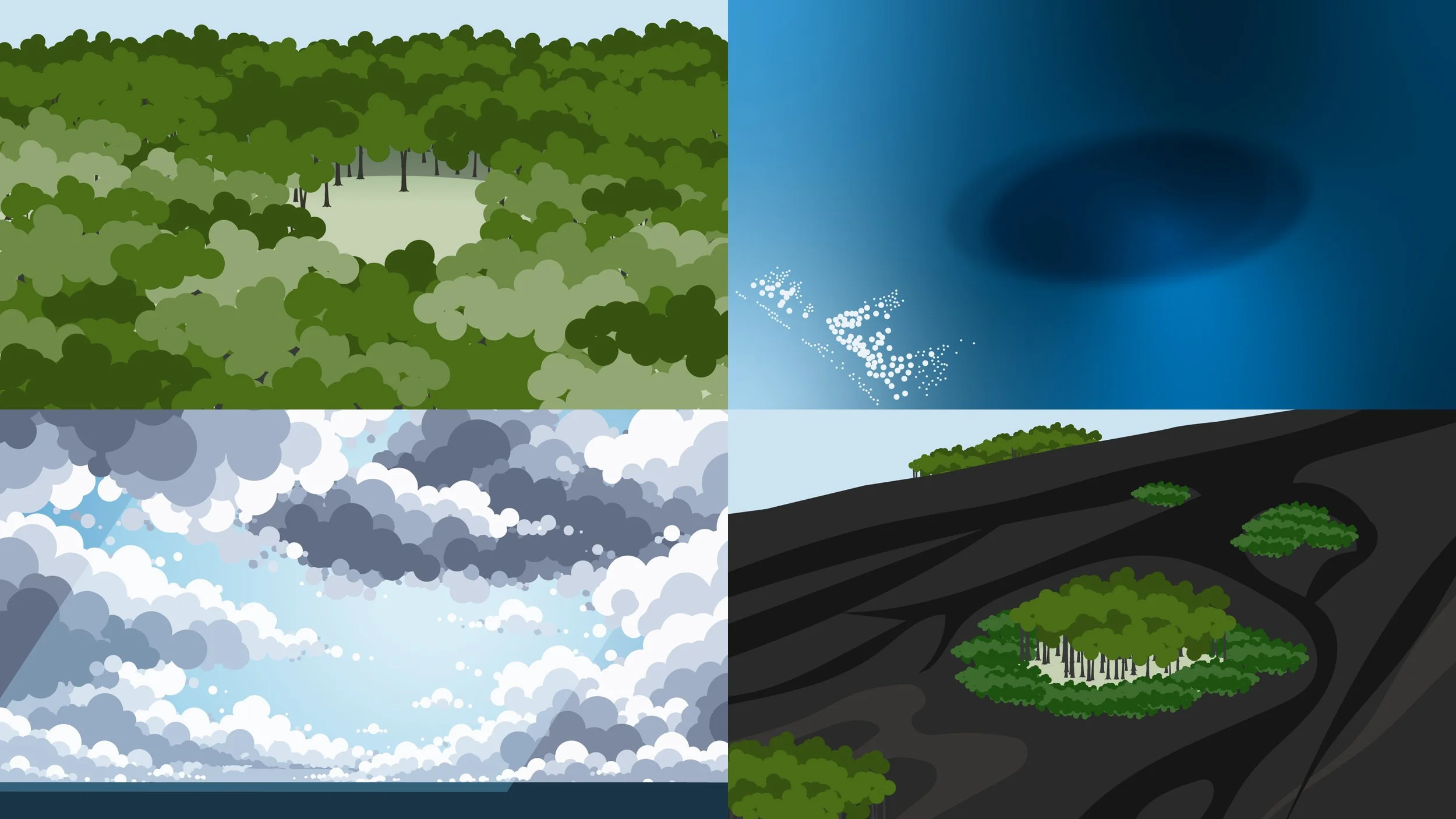
The Pukui-Elbert Hawaiian Dictionary gives kīpuka a primary meaning: “a variation or change of form.” It can also mean an opening or clear place, a calm patch in a high sea, a deep spot in a shoal, a break in the clouds, and, perhaps most evocatively, an oasis of vegetation spared within a lava bed.
That last sense entered English as a geological term: a remnant of older forest surrounded by a newer lava flow, spared because it occupied higher ground and the lava moved around it. An island of mature life framed by a fresh lava field.
Why it inspires us
As ecological designers and landscape architects, we can't look at a kīpuka and see only geology. We see a working model. These remnant forests are stages for resilience; evidence of what persists through disturbance. They're nodes of ecological connection, holding the seed stock and habitat that let life resettle back out across the flow. Further, they offer continuity of ecosystem services across generations, on a timescale most of our work only gestures toward.
But it's the dictionary's first meaning — a variation or change of form — that we keep returning to, because it lets us ask the question at the center of our practice:
What is a pocket of green in development, if not the natural echo of a pocket of forest in a lava field?
Kīpuka in the urban flow
A dense, paved, rapidly redeveloping city is its own kind of lava flow, a landscape being rewritten faster than the ecology beneath it can keep pace. In that setting, a courtyard, a restored stream corridor, a native planting along a campus edge, a pocket park — each performs as a kīpuka. A change of form spared or created within the flow of development, doing the same work the volcanic version does: holding ecology, reconnecting habitat that would otherwise be stranded, and returning shade, water, cooling, and seed to the blocks around it.
This is what drives us, a commitment to native ecosystem services delivered in the places they're hardest to keep.
We're clear-eyed about our limits. Any single project we install is a marker of new growth, not a finished forest. On its own, no courtyard or corridor untangles the full knot of ecological problems our communities face. But a kīpuka never worked alone either. Its power is that it belongs to a system; one node among many. Each space capable of reseeding the ground around it, together making the whole more resilient than any one of them could be. That system is what we design for.
Mahalo
To everyone who has known and trusted us as Ki across these nearly twenty years — clients, prime consultants, collaborators, and the communities who've let us work on their ground — mahalo. You're the reason there's a practice here worth renaming.
Legally, we're still Ki Concepts LLC. What's changed is the form. This blog is part of that change: a place to think out loud about resilience, native ecology, and the future of designed landscapes in Hawaiʻi — with the kīpuka as our through-line.
— Studio Kīpuka
New Leaf, Same Roots.